

By Brian Wise | From the May/June 2026 issue of Strings
When Knoxville, Tennessee, violin maker Kelvin Scott created a set of violins featuring intricately carved heads atop their pegboxes, he saw it as a chance “to do something a little more flamboyant” without affecting the sound or playability of his instruments. He commissioned Lloyd McCaffery, a wood carver specializing in miniatures, who delivered two with female heads and one in the form of a lion with a mouse on its back. Scott affixed these to the necks of three new violins.
Advertisement
More than five years after their completion, Scott says he has yet to find a customer for his elaborate creations. “Sadly, I have found that there is not much of an appetite for this work in the marketplace of high-end violins,” he says. “Fiddlers seem to have a great willingness to embrace unorthodox designs, woods, inlays, and carvings, but my main market is for classical players.”
Scott adds, ruefully, “There’s a very deeply entrenched idea of what a violin looks like, and these heads fall into the category of something you see on a fiddle, not a violin.”

Scott’s effort to revive the tradition of head carvings was not so outlandish when considering the flights of fancy that topped various early modern-era stringed instruments. These include heads of mythological gods, blindfolded cherubs, and satyrs; peasants and racial caricatures; monsters and various hybrid creatures. They seldom turn up in auctions, let alone the string sections of orchestras, but they provide vivid evidence of how some early makers were often not only craftspeople but also sculptors and painters.
Several of these instruments will be on display as part of Musical Bodies, an exhibition at New York’s Metropolitan Museum of Art that runs from June 7 to September 27. It is described as the first major museum show to explore the relationship between bodies and musical instruments, gathering some 130 instruments, paintings, sculptures, and drawings from around the world. Along with a circular keyboard, one of Prince’s guitars, and Nam June Paik’s TV Cello sculpture, the exhibition contains some 19 bowed stringed instruments, some from the Met’s holdings and others loaned from European and American collections.
Anthropomorphic Associations
The violin takes top prize as the instrument that most often stands for the human figure, says Bradley Strauchen-Scherer, curator in the Met Museum’s Department of Musical Instruments. “Sometimes it’s hardwired in us to talk about instruments as human bodies, but sometimes it’s very deliberate,” she says. “Because musical instruments are central to human activity and human identity, much of how we view the world through our bodies gets mapped onto these instruments.”

Instrument terminology is steeped in anthropomorphic terms, from the viola da gamba (“on the leg”) to the lira da braccio (“arm lyre”). By the 16th century, stringed instruments were known to have necks, bodies, bellies, and heads. When Andrea Amati designed some of the first classical violins, he drew on his dual interests in classical Greek architecture and human proportions, says Strauchen-Scherer. This especially inspired his approach to the scroll, which was a take on the ionic column—itself associated with a graceful female body. “The volutes of the top of that column suggest curled hair,” she says. “It would surprise all of us if Amati wasn’t aware of all of that.”
From there, it wasn’t such a creative leap to replace the scroll with a carved decorative head, which could hold an allegorical or symbolic meaning.
Advertisement
Some of the earliest examples of carved heads on bowed stringed instruments can be found early on French viols from 17th century. In many cases, the makers subcontracted these decorations to a carver known as LaFille, whose heads often displayed rounded features, arched eyebrows, and thinly closed eyes. More striking are the viols of Michel Colichon, which often featured “pirate-like” heads, as seen on a 1693 viol with wavy hair, a turban, and a flamboyant mustache.
Yet these were positively subdued when compared to 16th- and 17th-century Italian citterns (predecessors of the guitar), which often used grotesques to express “rich iconographic narratives,” according to Esteban Mariño Garza in a 2024 dissertation at London’s Royal College of Music. Motifs included “growling mouths with fangs . . . screaming faces with their tongues sticking out, a transforming Aphrodite, sirens being born out of a shell, and a female monster whose arms turn into leaves that extend all along the back of the instrument.”
Garza, now a historical-instrument specialist at the University of Edinburgh, points in an email to a Girolamo Virchi cittern at the Kunsthistorisches Museum Vienna. On its finial is a depiction of the myth of the suicide of the Roman noblewoman Lucretia, packed with symbolic details.

Early Modern Violins
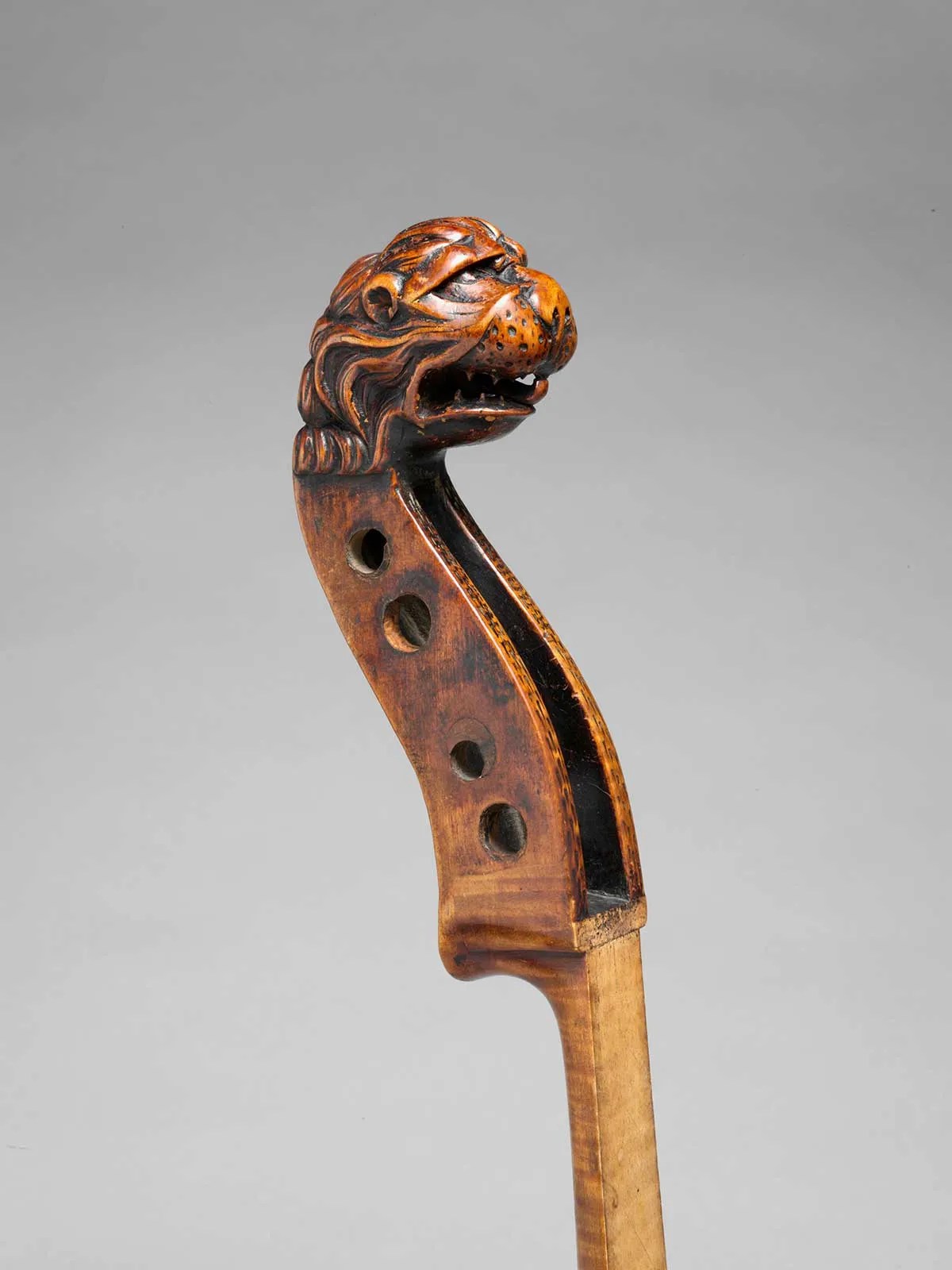
Among early modern violins, the Austrian maker Jacob Stainer often featured lion-like heads atop his violins, but the greatest source of this ornamentation was the Hamburg workshop of Joachim Tielke. The Met’s collection includes a particularly fanciful cello pegbox (c. 1685) attributed to Tielke that features a feline head with a snarling, fanged expression and a flowing mane.
More laden with symbolism is the carved head of a Moorish king that surmounts a Tielke cittern. “The back is all inlaid with ebony and ivory,” Strauchen-Scherer says of the instrument, which is on display in the Met’s musical instrument galleries. “So, this is about the wealth and prestige of those materials. It’s about Europe engaging in trade with Africa and the Middle East. And not only are they trading in materials, but they’re also trading in people. When you have a scroll like that on an instrument, nothing exists in isolation.”
Though carved heads were never embraced by the workshops of Stradivari or Guarneri, the decorations held their place among folk and dance instruments. The Met’s collection includes several pochettes, slender dance masters’ fiddles that often have carved heads portraying Greek gods, peasants, and people of non-European ancestry.
Similar in function are hardanger fiddles (or hardingfeles), which often feature carved heads tied to Norwegian identity. An ornately decorated Lars H. Savill fiddle (1931) on display at the National Musical Museum in South Dakota features a girl’s face and hair, with round cheeks and a cap for Norwegian winters. Other examples have dragons and stylized lions, honoring Norway’s coat-of-arms, as seen in a 1920 fiddle in the Met Museum’s collection.
Advertisement

American, Photo: The Metropolitan Museum of Art
Strauchen-Scherer marvels at an 1885 American folk fiddle by Philip Henry Holmes. “I always jokingly refer to it as the Annie Oakley fiddle because it has a young girl wearing a cowboy hat,” she says. “The edge of the back of the instrument is all carved with a garland of flowers, a dove, and a little cross. It’s my hunch that it may have been made as a memorial to the figure depicted on the scroll.”
More Decorative Than Practical
However enchanting and fanciful, the protruding figures atop violin pegboxes and scrolls inevitably raise questions about their vulnerability to damage. Unlike f-holes, which are both decorative and acoustical in function, pegbox carvings hold little practical value. And such instruments may have always been intended as decorative objects rather than workaday tools.
They rarely turn up in auctions, says Jason Price, director of the auction house Tarisio. “The serious classical violin making traditions very rarely used human or animal heads,” he writes in an email. “Yes, there are great Stainer instruments with carved heads and some wonderful 18th-century French and Dutch heads as well . . . but the ‘serious’ 17th- and 18th-century traditions of Cremona, Brescia, Milan, and Venice didn’t use figurative heads.”
Across national schools and instrument families, there are always questions involving gender. “It’s fairly standard in instrument design and art history that the body of the instrument is this wonderfully voluptuous female form,” says Strauchen-Scherer. “But when you find literary illusions to the necks of viols—as in madrigals—they’re often portrayed as being phallic. Then, [a carved head] on the top of that neck may be male or female. So, in some ways, a violin or a viol represents a totality.”
The Musical Bodies exhibition will feature an extraordinary, anthropomorphic lira da braccio by Giovanni d’Andrea (1511), featuring a stern-looking man’s face adorning the arch of its back and a woman’s figure on the arch of the soundboard. The pegbox is adorned with a plummy male face. “For a very long time that instrument has been written about in the literature,” Strauchen-Scherer says of the lira, which resides at the Kunsthistorisches Museum Vienna. “People talk a lot about its string length and technical terms. But most people talk only very briefly about its figural aspect, concluding that it’s bacchanalian, it’s lewd.”
Advertisement
But after studying other art from across the Met’s collections, Strauchen-Scherer came to a more specific reading. “It’s not: one side is male and the other side is female. I think, very specifically, it’s a single being; it’s the Divine Androgyne that you often read about in Renaissance literature.” This refers to the philosophical concept involving the transcendental union of the sexes (through marriage) in what is also sometimes known as the “Universal Androgyne.”
Whatever the intended symbolism of d’Andrea’s instrument, it proved a creative dead end as the lira da braccio gave way to the violin. Soon came the streamlining. “We now have a very lean instrument in terms of the adornment,” says Scott, the Knoxville luthier. “Purists will say, ‘Well, the beauty of the violin is in the shapes, the lines, the curves, the modeling, the arching. I think that’s a bit of the tension that we struggle against when we try and impose decoration on the instrument again in our age.”
But experiments persist. In the early 1980s, Gregg Alf, an American violin maker now based in London, carved a one-off viola scroll featuring the head of E.T. (from the 1982 film E.T.: The Extra-Terrestrial). But soon after finishing it, he considered the risks of trademark infringement and removed it from the instrument.
When asked about it, Alf says that for years he hoped to someday reunite the scroll with a viola of his making, so the instrument could be played as a complete viola. He now intends to try again. “I am writing to Universal to request permission, or a letter of no objection, to complete the viola on a strictly one-off basis,” he says.
For now, it stays in his workshop. As the charming alien itself might say, “I’ll be right here.”
Advertisement


